metallic bond – the strong electrostatic attraction between a lattice of positive metal ions and a "sea" of delocalised (free-roaming) negative electrons
(pronounced muh-ta-lik bond)
To remember the meaning of metallic bond, use the following mnemonic:
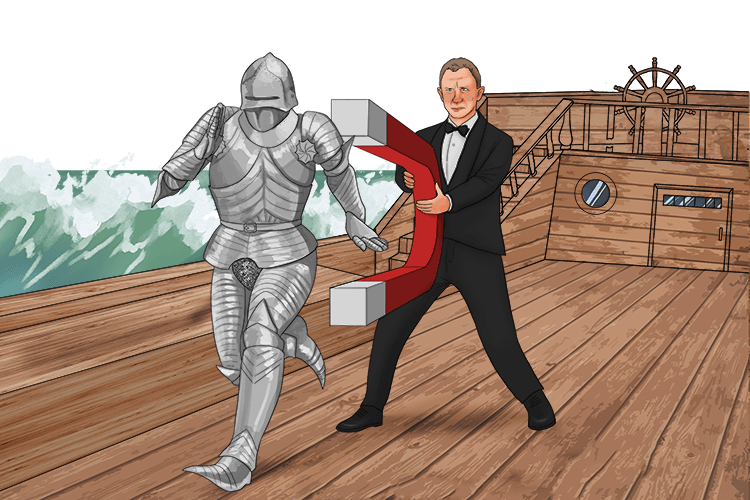
The dangerous man wearing metallic armour tried to run from James Bond (metallic bond), but he stayed strongly attracted using magnets while they fought at sea.
Metallic bonding is the type of bonding that occurs in metals and metal alloys. In a metallic bond, the metal atoms lose their outer electrons to form positive ions, and these electrons become delocalised, meaning they are free to move throughout the entire structure rather than being attracted to any specific atom. This creates a "sea of electrons" that surround the positive metal ions and holds them together through strong electrostatic attraction between the positive ions and the negative electrons. (Electrostatic force is simply the force between charged particles. It doesn't mean "electricity that is static" it means electrical force).
The unique bonding structure explains many of the characteristic properties of metals, such as their ability to conduct electricity (because the electrons can move freely) and their high melting and boiling points due to the strong forces of attraction throughout the structure.

How can metals have such strong forces of attraction between the metal ion and the electron when the electron is free to move around?
This is an excellent question because it hits on the very paradox that makes metallic bonding so unique and fascinating. The key is to understand that electrons are not "free" in the sense of being completely independent; they are "free" within the constraints of a very strong, collective attractive force. This means the electrons are not bound to a single, specific atom but are shared among all the metal ions in the lattice.
Think of it as this:
- In an ionic compound, like NaCl, an electron is transferred from Na to Cl. The electron now "belongs" to a specific chloride ion.
- In a metal, the outer electrons are donated to a "sea" that belongs to the entire structure. No single electron "belongs" to any single ion.
While a single electron is not tightly bound to a single ion, it is constantly experiencing attractive forces from many positive metal ions (cations) that make up the lattice.
At any given moment an electron is passive very close to one or more positive ions. Even though an individual electron moves away from one ion, it immediately feels the strong pull of the next ion in the lattice. It's never truly "free" from the attractive influence of the positive charge; it just moves from being attracted to one ion to being attracted to another.