plum pudding model – theory that suggested the atom was a sphere of positive charges with negative electrons embedded in it
To remember the meaning of plum pudding model, use the following mnemonic:
Imagine what J.J. Thomson proposed i.e. a pudding (sphere of positive charges) with plums (smaller negative charges) embedded into it like a traditional plum pudding.
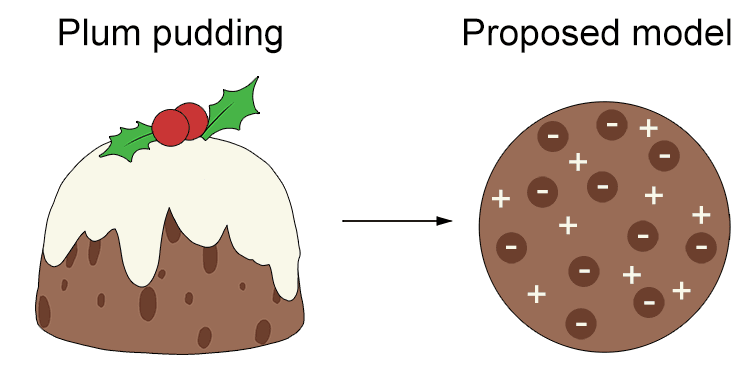
This plum pudding model was an early atomic model proposed by J.J. Thomson in 1897, after he discovered the electron. In this model, Thomson suggested that the atom was a sphere of positive charge with tiny, negatively charged electrons embedded throughout it, much like plums or raisins scattered through a pudding.
A diagram of J.J. Thomson's plum pudding model looks like the following:

This model was significant because it was the first to recognise that atoms contained smaller particles (electrons) rather than being solid spheres as previously thought.
However, this theory was disproved as it was discovered that an atom actually has a small, dense, positively charged nucleus at the centre with electrons orbiting around it.
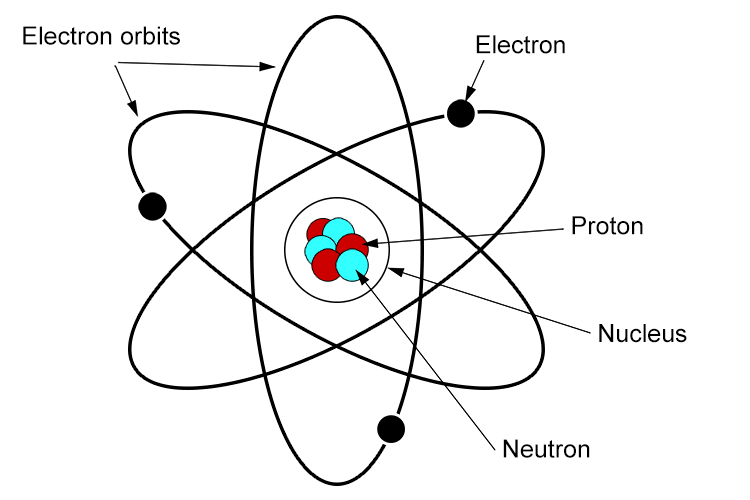
Despite being disproven, the plum pudding model is a good example of the evolution of scientific theory.