Does China use the metric system of weights?
China does use the international systems of units (SI) and it was made law to do so officially on 16th February 1929. You will see on packets in shops 80g or 30grams.
However, a large number of Chinese people and companies still use the traditional Chinese system of weights and measures in everyday life i.e. jin and liang.
Kilograms
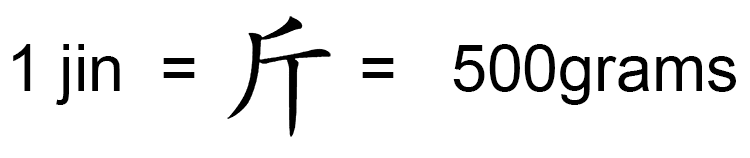
One kilogram is called a gōngjīn or gongjin (pronounced gong-jin) although sometimes market places or stalls work in jīn or jin (pronounced jin). One jin is equivalent to half a kilogram.
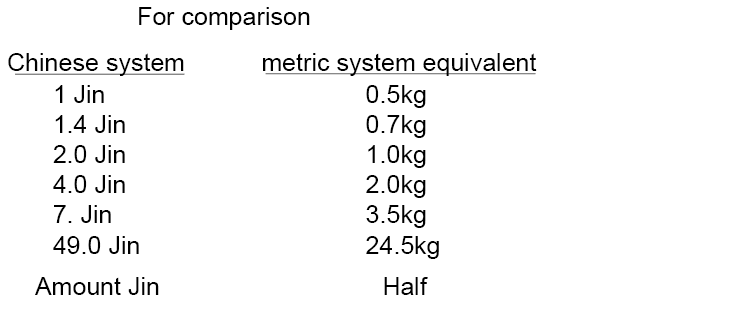
So if a Chinese market stall weighs out 2 jin of tomatoes, you know you have one kilogram of tomatoes.
Grams
One gram is called a kè or ke (pronounced ker).
Some market places or stalls work in the traditional Chinese liăng or liang (pronounced lee-ung). One liang is equivalent to 50 grams.

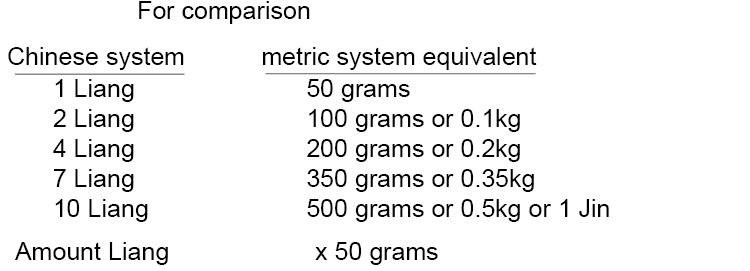
So if a Chinese market stall weighs out 10 liang of grapes, you would have 500 grams, half a kilogram or 1 jin of grapes.