current-carrying wire – a conductor, like a wire, through which an electric current flows
To remember the meaning of current-carrying wire, use the following mnemonic:
Current-carrying wire
Mix it up
Wire, carrying current
The two phrases mean exactly the same thing but scientists believe that putting current first is the most important thing and people will pay attention more to the fact that current is flowing here. This has now become a standard in physics.
A current-carrying wire is any electrical conductor, typically made of metal such as copper, through which an electric current is flowing due to the movement of charged particles (electrons) along its length. When a potential difference (voltage) is applied across a wire, it creates an electrical field that causes free electrons within the metal to drift in a particular direction, creating an electrical current that flows from the negative terminal to the positive terminal of a power source.
Current-carrying wires produce a magnetic field when electrically charged, which can be demonstrated by placing a compass near the wire and observing the needle deflect.
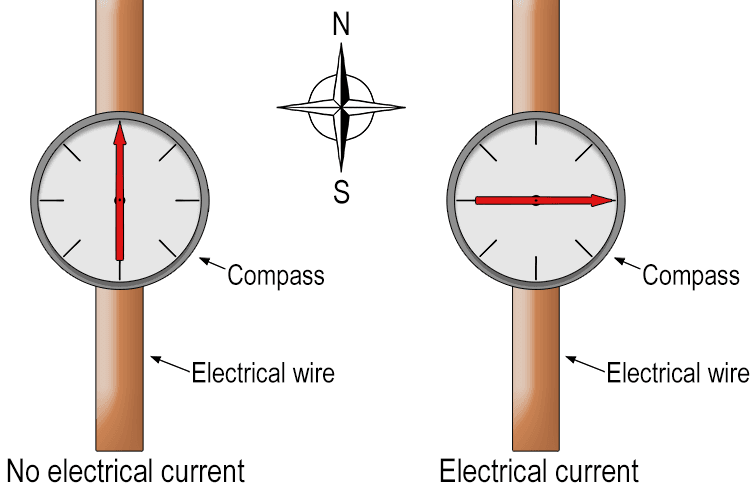
The direction of the magnetic field around the wire depends on the direction of the current flow and can be determined using the right-hand grip rule.
Current-carrying wires and the magnetic fields they produce are an integral part of devices such as electromagnets, electric motors, and generators.