protostar – a young star that is still in early stages of formation from a mass of gas and dust
(pronounced proh-toh-star)
To remember the meaning of protostar, use the following mnemonic:
The prototype model of the star (protostar) was not fully formed.
A protostar is the earliest stage in the formation of a star, called a nebula, which begins to collapse under the force of its own gravity. As the cloud contracts, the particles fall inward and collides with each other, which causes the temperature and pressure at the centre to increase significantly. The protostar continues to grow as more material is pulled in by gravity, becoming denser and hotter over time. Eventually, when the core temperature reaches around 100 million degrees Celsius, hydrogen nuclei begin to fuse together in a process called nuclear fusion, releasing enormous amounts of energy. At this point, the protostar becomes a main sequence star, entering the stable phase of its life cycle where it will spend most of its existence.
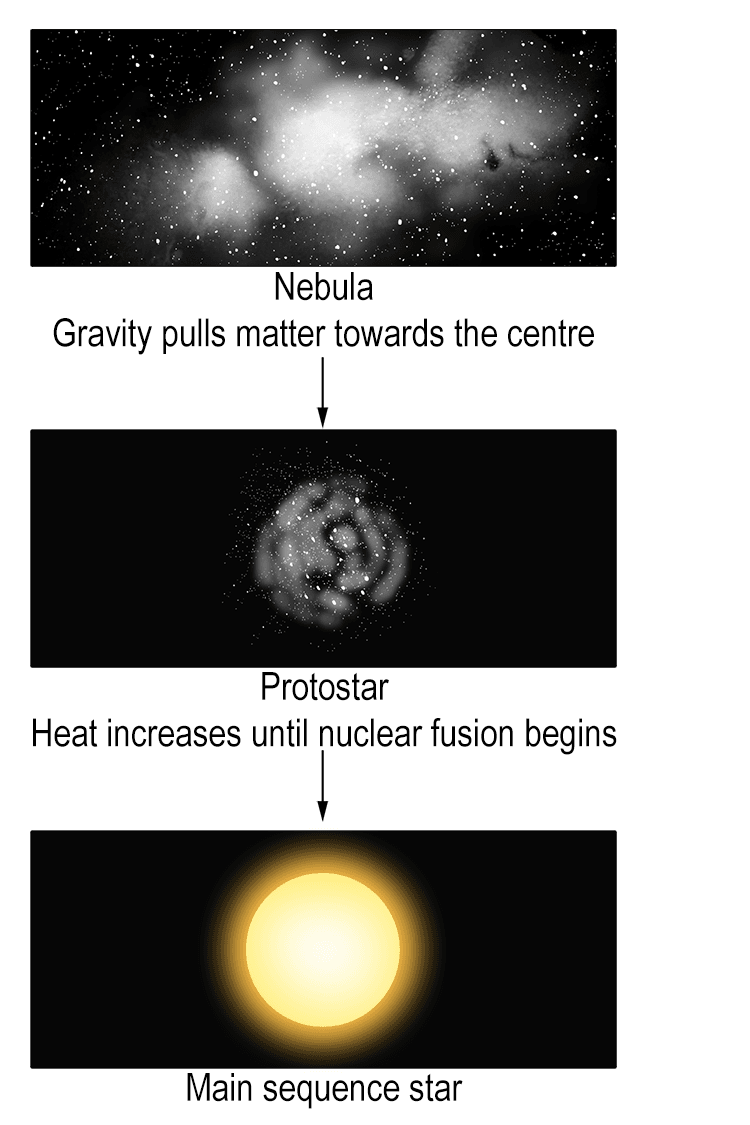
Our sun was once a protostar. About 4.6 billion years ago, the cloud of gas and dust that became the sun began to collapse under gravity but it did not yet produce energy by nuclear fusion.
Once the centre of our sun became hot and dense enough for hydrogen fusion to begin it officially became a star, a main sequence star.
These were the stages of our sun.
- Nebula - a large cloud of gas and dust.
- Protostar - gravity pulls material inward heating it up.
- Main sequence star - nuclear fusion starts (this is what the sun is now).
The sun is estimated to remain a main sequence star for a total lifespan of approximately 5 billion years.
Our sun is called a "yellow dwarf" because of its colour and size. It is on the smaller end of possible star sizes and emits most of its light in the visible spectrum.