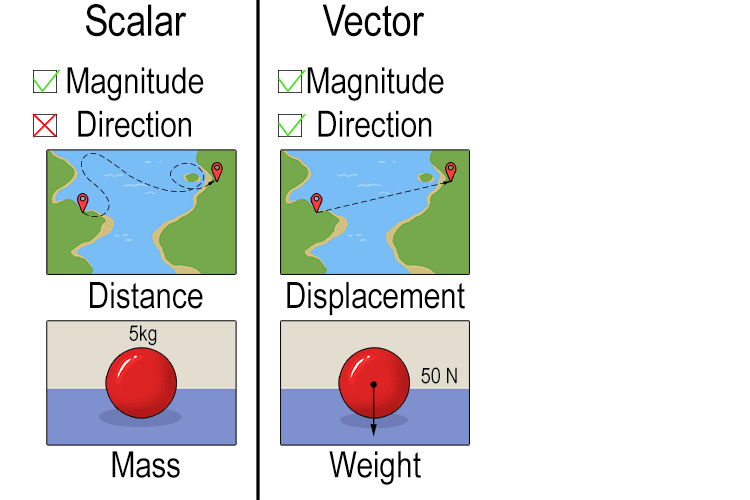
scalar quantities – measurements that are described by their magnitude alone without specific direction: Think just a number
(pronounced skay-luh)
Note: You must read this and the word vectors together.
To remember the meaning of scalar quantities, use the following mnemonic:
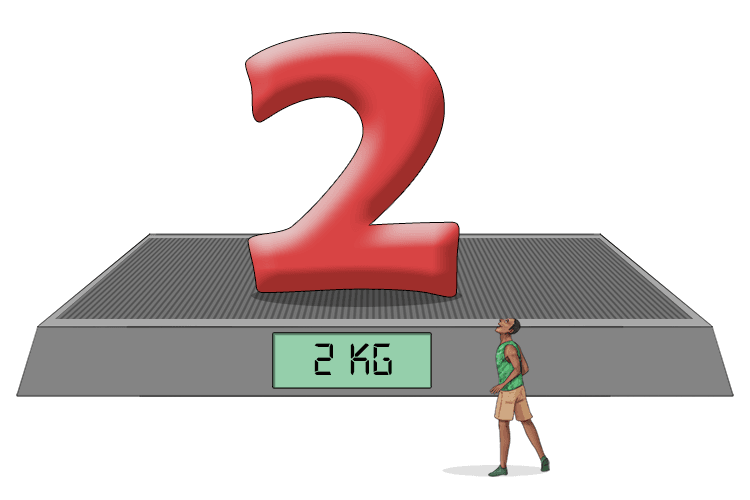
On the giant scale was just a (scalar) single number.
Scalar quantities are physical measurements that have only magnitude (size or amount) and no directional component, meaning they are fully described by a numerical value and appropriate unit without needing to specify a direction. These quantities represent simple measurements of "how much" of something exist, such as distance, speed, mass, temperature, time, energy, and volume.
For example, if you walk 3 metres forward and then 2 metres backward, the total distance travelled is 5 metres (a scalar quantity) because distance only considers how far you've travelled regardless of direction, whereas displacement would account for direction and be only 1 metre forward.
Scalar quantities are straightforward to work with mathematically because they follow normal algebraic rules: adding 5 kilograms to 3 kilograms always gives 8 kilograms, and multiplying a speed of 10 metres per second by a time of 5 seconds gives a distance of 50 metres.
The difference between scalar quantities and vector quantities is that vector quantities have both magnitude and direction. This can be seen in following comparisons: