spring constant – a measure of a spring's stiffness
Note: Spring constant is denoted by the letter 'K' and the greater the value, the greater the force required to stretch or compress the spring.
To remember the meaning of spring constant, use the following mnemonic:
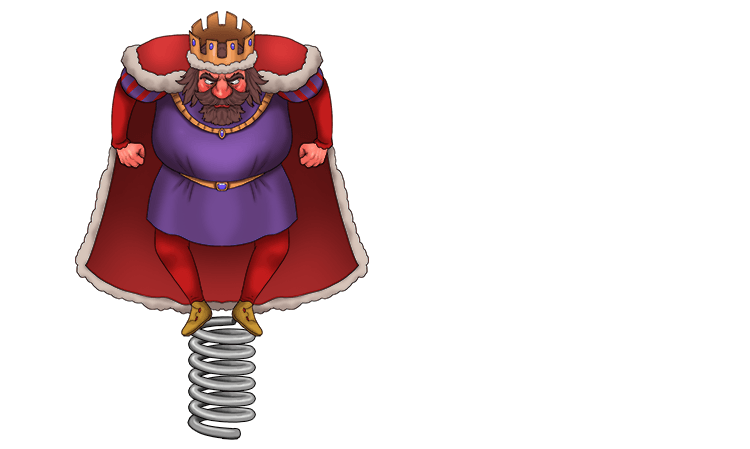
The spring had a constant (spring constant) pressure on it, but its stiffness meant that the King (K) could not compress it.
The spring constant is a measure of the stiffness of a spring, represented by the symbol K and measured in newton per metre (N/M). It tells you how much force is needed to extend or compress a spring by a given distance.
A spring with a large spring constant is very stiff and requires a lot of force to stretch it, whereas a spring with a small spring constant is easier to stretch and compress. The spring constant is used in Hooke's law. Hooke's law states that the force needed to extend a spring is directly proportional to the extension, meaning if you double the force you double the stretch.
Hooke's law is expressed by this formula:
Force (newtons) = spring constant (k) x extension (metres)
or
F = k x e
To remember Hooke's law, use the following mnemonic:
Hook (Hooke) a frog (f) and it will kick (k) you in the eye (e). (F = k e).

The relationship only applies within the elastic limit of the spring, meaning the spring will return to its original length when the force applied to it has been removed.
For example, by hanging a 2 newton weight on a spring and stretching it 0.004 metres (4cm), you can calculate the spring constant using Hooke's law, F = k x e. Rearranging the equation gives K = F ÷ e, so K = 2 ÷ 0.004 which equals 50 newtons per metre, indicating that for every metre you stretch the spring, you would need 50 newtons of force. In practical terms, if you wanted to stretch the spring another 4cm (double the original extension), you would need to double the force to 4N.