upthrust – the upward force acting on an object in a fluid (liquid or gas)
(pronounced up-thrust)
To remember the meaning of upthrust, use the following mnemonic:
The balloon went up after it was thrust (upthrust) into the water.
Also use the following visual experiment to remember that
Upthrust = Weight of Fluid Displaced
Where Weight = Force and the force = m x g.
Now put a small boat in the suspended tank.
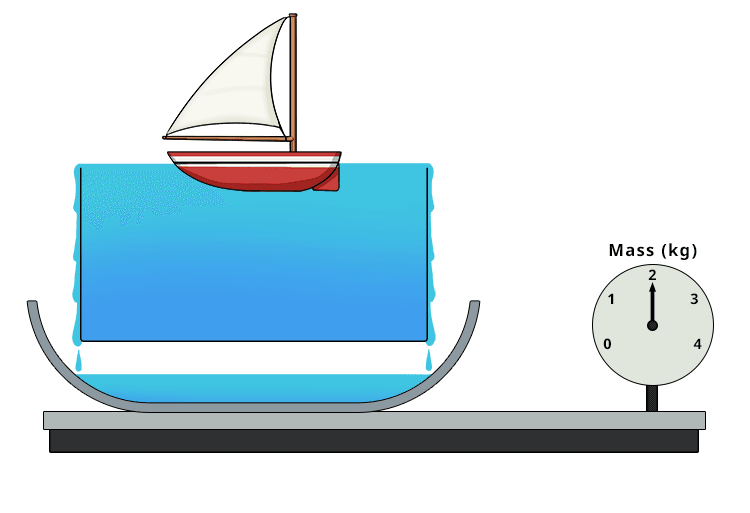
Upthrust = Weight of Fluid Displaced
Upthrust = Mass x Gravitational Force
Upthrust = 2kg x 9.8m/s2 = 19.62 Newtons
For a boat to float the upthrust must equal the weight of the boat.
Upthrust = 19.62N
Weight of boat = 19.62N
If you add heavy cargo, the boat sinks deeper, displacing more water, which increases the upthrust.
Upthrust, also known as buoyancy or buoyant force, is the upward force exerted by a fluid on an object that is partially or fully submerged in it, and this force acts in the opposite direction to the weight of the object.
Upthrust = Weight of Fluid Displaced
But to know if an object will be buoyant or sink you need to compare.
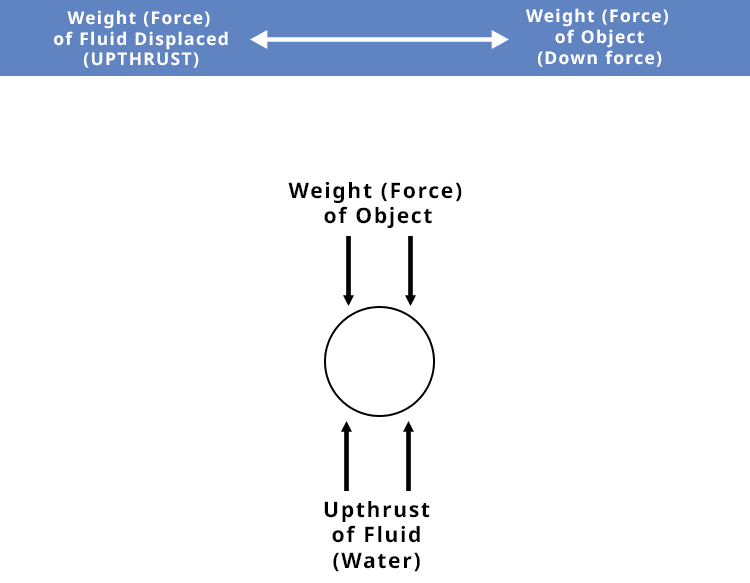
Floating Upthrust = Weight (Force) Object
Sinking Weight (Force) Object > Upthrust
Rising Upthrust > Weight (Force) Object
There is a different experience in forces between the top of the object and the bottom of the object.
Example 1
A block of steel is suspended from a spring balance. The spring reads 10N. The block is then slowly lowered into a jug of water until it is completely submerged. The spring balance now reads 8N. Calculating the upthrust (buoyant force) exerted by the water on the block:
When the block is hanging in the air, the spring balance measures a weight of 10N. This is the force of gravity pulling it down. When you put the block in the water, the water pushes upwards on the block. This upward pushing force is the upthrust.
Because the water is pushing the block up, the block isn't pulling down as hard on the spring balance. The balance therefore shows a lower reading, which we call the apparent weight (8N). The upthrust is simply the difference between two reading.
Upthrust = weight in air - Apparent weight in water
Upthrust = 10N - 8N
Upthrust = 2N
The upthrust exerted by the water on the metal block is 2 Newtons (N).
Example 2
A solid metal cube with a volume of 0.002m3 is completely submerged in water. The density of the water is 1,000 kg/m3 and take the gravitational field strength (g) to be 10N/kg. Calculate the upthrust acting on the cube:
Upthrust = weight (force) of displaced fluid
Weight (force) = m x g
Density = `m/g`
Therefore
Weight (force) = Density x Volume x g
Weight (force) = 1,000kg/m3 x 0.002m2 x 10N/kg
Weight (force) = 20N
Note: You must use the density of the fluid NOT the density of the object.
Example 3
A wooden raft floats on water. The raft has a mass of 80kg and take gravity to equal 10N/kg. Calculate the upthrust.
Upthrust = weight (force) of displaced fluid
Weight (force) = m x g
Weight (force) = 80kg x 10N/kg
Weight (force) = 800N
The upthrust acting on the raft is 800N. The raft is floating so the forces are balanced. Therefore the upthrust is equal to the weight of the raft.
If the raft sinks deeper when a 20kg person stands on it what is the new upthrust.
Weight (force) = (80kg(raft) + 20kg(person)) x 10N/kg
Weight (force) = 100 x 10
Weight (force) = 1000N
Example 4
A balloon is forced underwater. The balloon weighs 2N the water displaced has a weight of 30N. What is the resultant upward force (not the upthrust).
The water displaced = 30N therefore
The upthrust = 30N
Balloon weight (force) = 2N
Resultant force upward
30 - 2 = 28N upwards
(this is a lot and is why the balloon rises quickly)
If the balloon were floating on the surface only a tiny amount of upthrust would be needed to make it float (2N) and only an equal tiny amount of water would be displaced.
If a balloon is dragged down deep in the ocean the water pressure increases, the balloon gets compressed and the volume of the balloon gets smaller. The balloon displaces less water because:
Upthrust = weight of fluid displaced
Upthrust = force
Upthrust = m x g
so
Upthrust = density x volume x g
If the volume decreases the upthrust decreases.
Near the surface
Balloon volume = large
Water displaced = large
Upthrust = large
Deep in the ocean
Balloon volume = smaller (compressed)
Water displaced = less
Upthrust = smaller
Note: If the object were (for example a solid metal sphere), the volume would not change, so the upthrust would stay the same at any depth.