cloning – the process of creating a genetically identical copy of a cell or organism
(Pronounced kloh-ning)
To remember the meaning of cloning, use the following mnemonic:
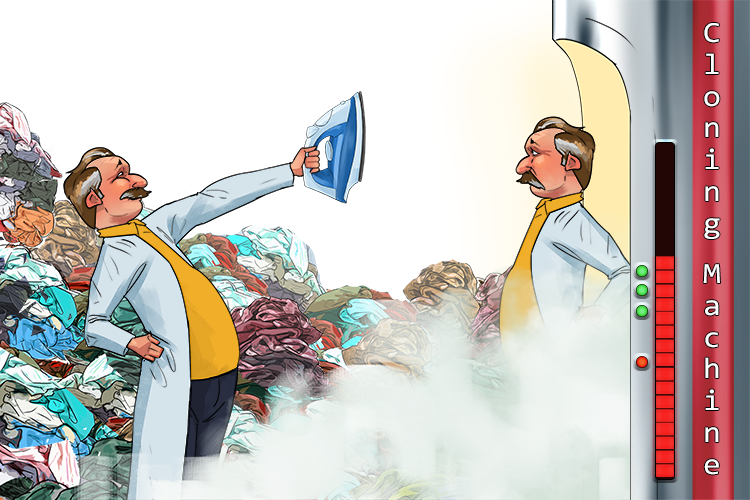
My clothes needed ironing (cloning) so I got an identical copy of myself to do it for me.
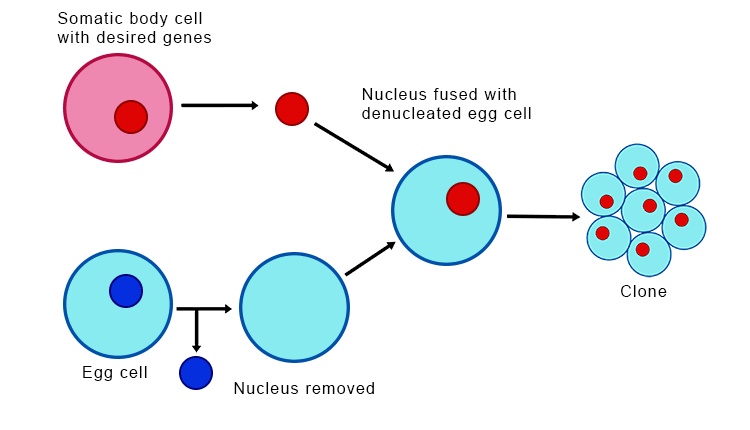
In biology, there are different types of cloning: natural cloning occurs when organisms reproduce asexually, such as bacteria dividing or plants growing from cuttings, resulting in offspring that are exact genetic copies of the parent. Artificial cloning can be done in several ways including tissue culture in plants, where small pieces of plant tissue are grown in sterile conditions to produce many identical plants, and animal cloning through a technique called somatic cell nuclear transfer. This involves taking the nucleus from a body cell of the organism to be cloned and inserting it into an egg cell that has had its own nucleus removed, which is then stimulated to divide and develop into an embryo that is genetically identical to the donor organism. The most famous example of animal cloning is Dolly the sheep, who was cloned in 1996 using this technique.