doppler effect – the change in frequency or wavelength of a wave as the source and observer move closer or further away
(pronounced dop-lur)
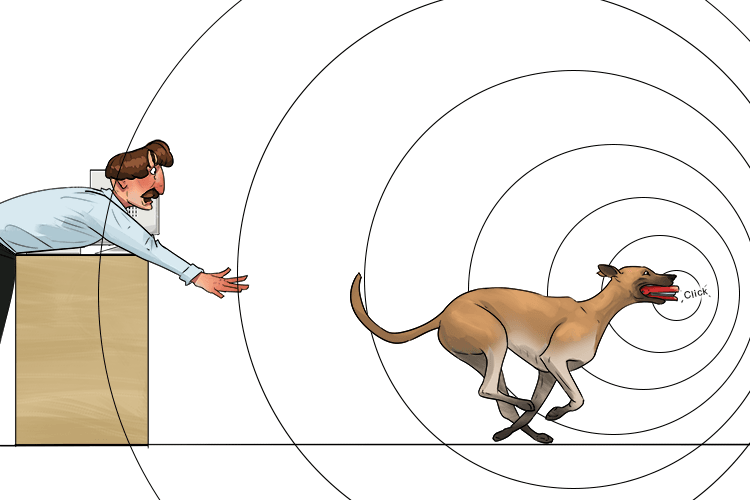
To remember the meaning of Doppler effect, use the following mnemonic:
The sound of the dog's stapler (Doppler effect) changed frequency as it ran back and forth (moving closer or further away).
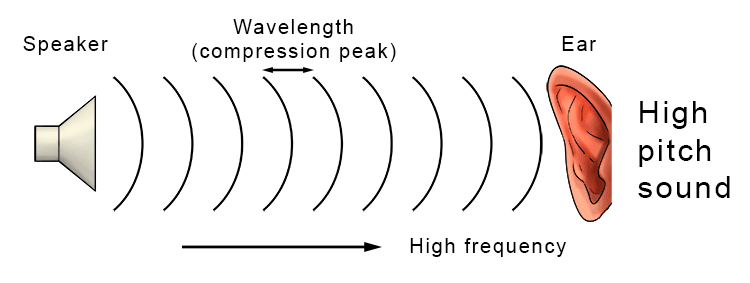
The key to understanding the Doppler effect is to first understand that:
High frequency sounds give a high pitched noise.
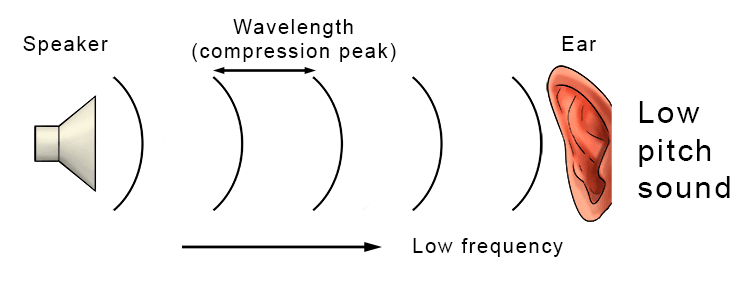
Low frequency sounds give a low pitched noise.
If a tuning fork omits a sound wave with a set frequency and the tuning fork and receiver (ear) doesn't move we will hear that frequency.
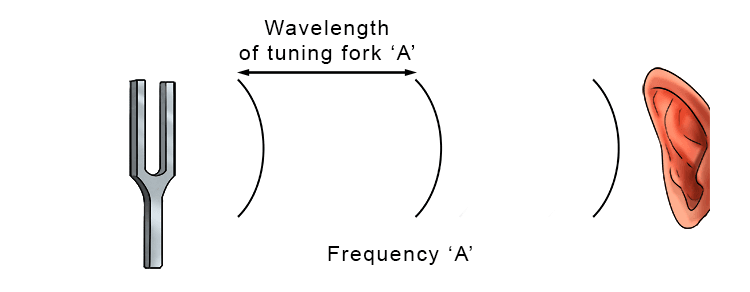
And if that tuning fork moves towards the receiver the wavelength shortens and the frequency increases. The receiver will detect the wave length as a higher frequency.
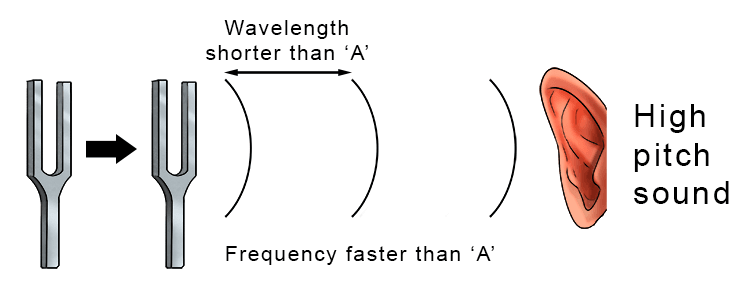
Inversely if the tuning fork moves away from the receiver the wavelength increases and the frequency reduces. The receiver will perceive the wave as a lower pitch sound.
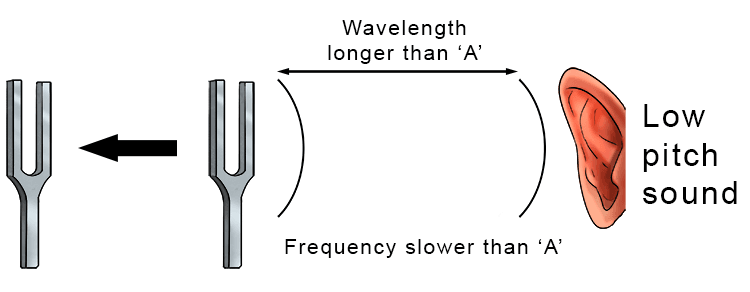
The Doppler effect is the observed change in frequency (and therefore wavelength) of a wave when there is relative motion between the source of the wave and the observer, resulting in the wave appearing stretched or compressed depending on the direction of movement. When a wave source towards an observer, or the observer moves towards the wave source, the waves are compressed together, resulting in a shorter wavelength and higher frequency, which is perceived as a higher pitch for sound waves. Conversely, when the source moves away from the observer, or the observer moves away from the source, the waves are stretched out, resulting in a longer wavelength and lower frequency, perceived as a lower pitch.
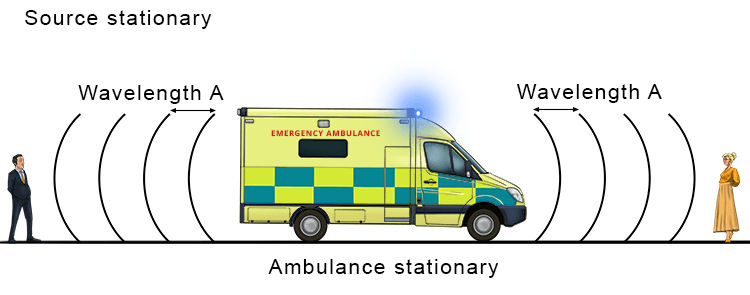
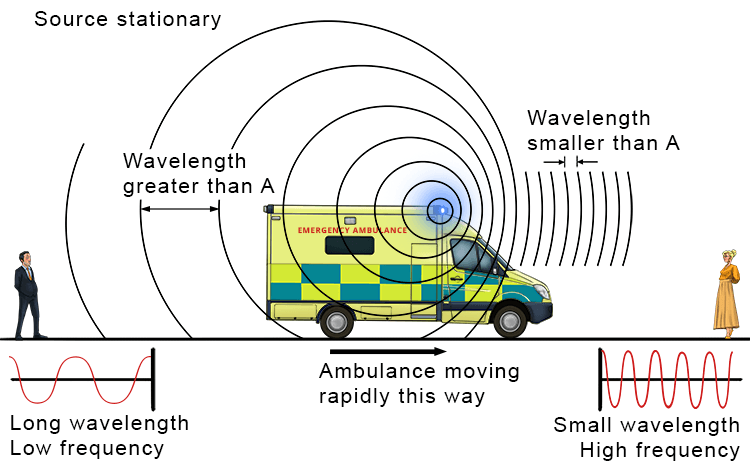
A common everyday example of the Doppler effect is the change in pitch of a siren on an emergency vehicle: as the ambulance approaches, the sound waves are compressed and the siren sounds higher pitched, but as it passes and moves away, the sound waves are stretched and the pitch drops to a lower frequency.
The Doppler effect applies to all types of waves including sound waves and electromagnetic waves like light, in which a well known example is red-shift in astronomy.