red-shift – the observed increase in the wavelength of the light emitted by distance galaxies
Note: Red-shift is the stretching of light waves.
To remember the meaning of red-shift, use the following mnemonic:
Little Red Riding Hood did a shift (red-shift) stretching light waves emitted by galaxies.

Red-shift is the phenomenon where light from distant objects in space, such as galaxies, appears to have shifted towards the red end of the spectrum, indicating that these galaxies are moving away from us and providing key evidence for the expanding universe. This occurs because of the doppler effect, which causes the wavelength of light to stretch (increase) when the source is moving away from the observer, similar to how the pitch of a siren sounds lower as the ambulance drives away.
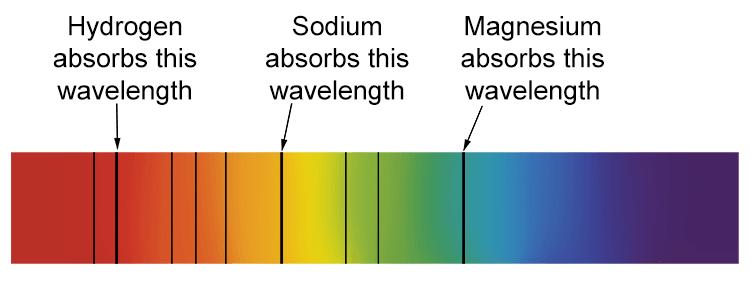
When you compare this with different stars these missing wavelengths have all shifted towards the red end of the light spectrum.
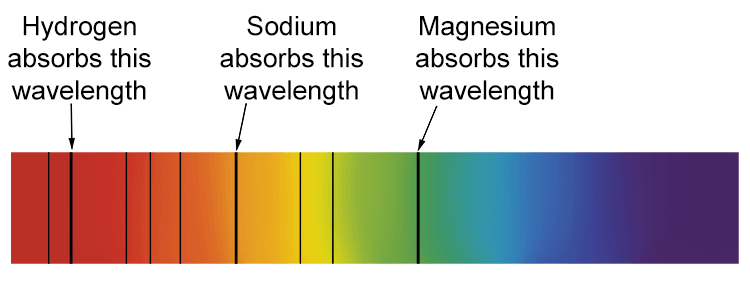
The wavelength either side of the missing wavelengths have all shifted towards the red end of the light spectrum. This means that they are longer wavelengths than the sun (the sun is used as a comparison standard).
Longer wavelength, frequency slower.
This can only mean one thing and we know that the doppler effect is occurring and the stars must be moving further away from us to become longer wavelengths.
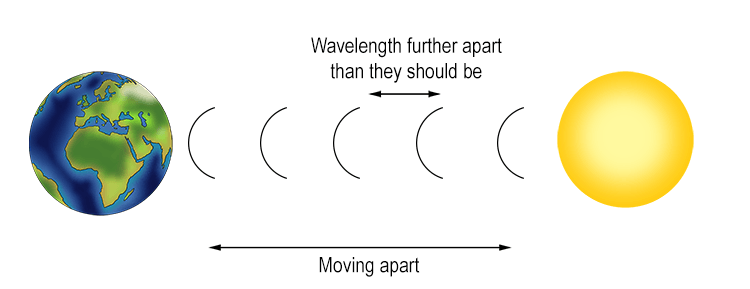
Scientists found that all distant galaxies have red-shift confirming the universes large-scale expansion.
Because the universe is expanding, it means in the past, all galaxies were closer together. If you trace the expansion backwards, all matter and energy converge at a single point (a singularity) which is the bases of the big bang theory.
The big bang theory suggests all matter in the universe began from a single, unimaginably hot and dense point approximately 13.8 billion years ago.

Note: The greater the red-shift observed the faster the star is moving away from us.
The opposite of red-shift is blue-shift where light gaps can be observed on the spectrum being closer to the blue end of the light spectrum. Here the light waves are shorter than the sun emits.
Shorter wavelength, frequency faster.
This can only mean that the star is moving closer to the Earth.
Our Milky Way galaxy containing hundreds of stars are moving closer to the Andromeda galaxy. This had been proven by looking at the blue shift between these two galaxies.