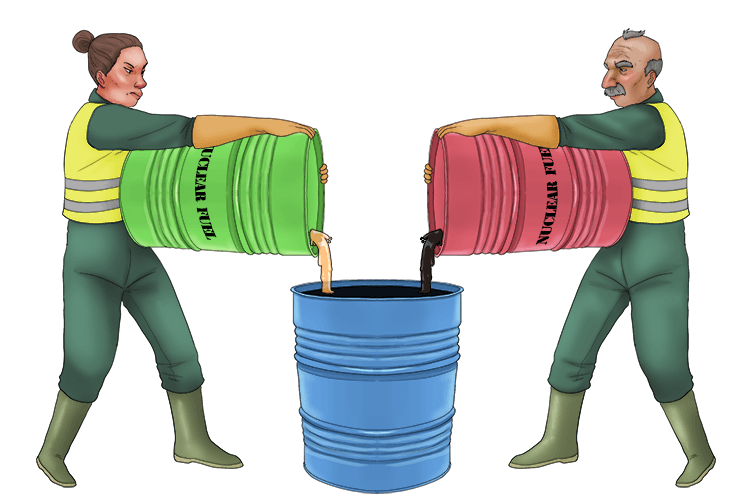
fusion – the nuclear process where two nuclei join together
Note: It's important to recall that fusion means join.
To remember the meaning of fusion, use the following mnemonic:
The fuel for the nuclear power station (fusion) was joined together.
Fusion is the process in which two light atomic nuclei combine or fuse together under extremely high temperature and pressure to form a heavier nucleus, releasing huge amounts of energy in the process. This process requires temperatures of millions of degrees Celsius to overcome the strong electrostatic repulsion between the positively charged nuclei, which is why fusion reactions naturally occur in the cores of stars, including our sun, where the intense heat and pressure conditions are met.
The most common fusion reaction in stars involves hydrogen nuclei (protons) fusing together to form helium nuclei and releasing energy in the form of light and heat.
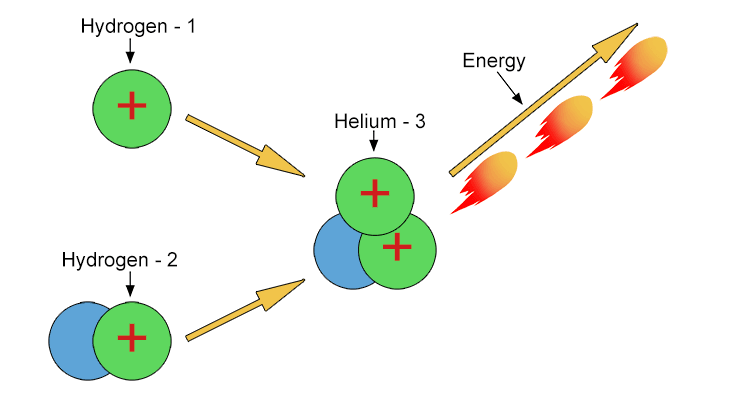
Fusion reactions release far more energy than chemical reactions or even fission reactions per unit of mass, making them an attractive potential source of clean, sustainable energy, though achieving the extreme conditions needed for controlling fusion on Earth remains a significant scientific and engineering challenge.