gamma ray – electromagnetic radiation (photons) released from unstable atomic nucleus
(pronounced gah-muh ray)
To remember the meaning of gamma ray, use the following mnemonic:
The gammon joint raced (gamma ray) away from the electronic magnet holding a radiation (electronic magnetic radiation) gun.

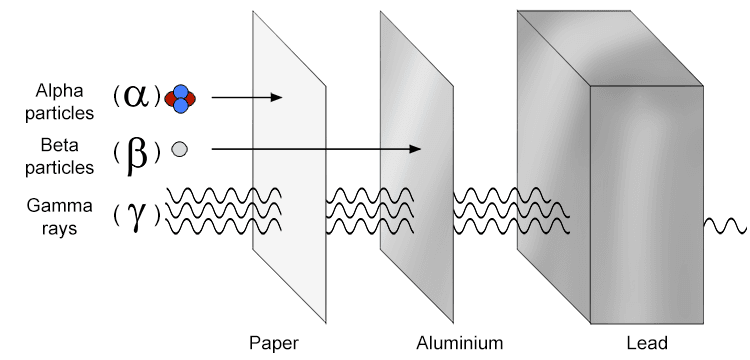
Gamma rays are a type of electromagnetic radiation consisting entirely of photons just like visible light, radio waves and x-rays. Gamma rays have the shortest wavelength and the strongest penetration in the electromagnetic spectrum, and are produced during radioactive decay when unstable atomic nuclei release excess energy. Unlike alpha and beta particles, gamma rays are not made of particles, but are high energy photons (packets of electromagnetic energy) that have no mass and no charge, allowing them to travel at the speed of light and penetrate materials much more deeply than other forms of radiation.
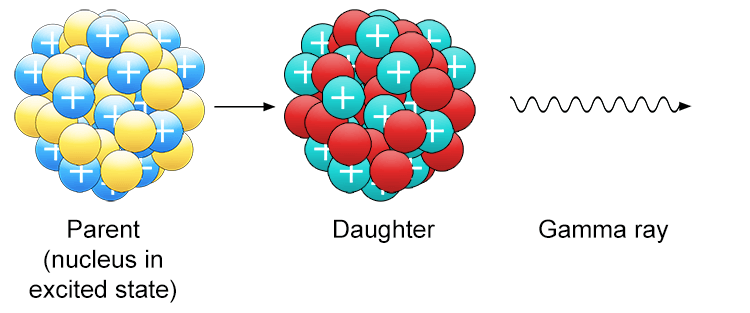
Gamma radiation is typically emitted by unstable atomic nucleus after they have undergone alpha or beta decay, as the nucleus releases energy to transition from an 'excited state' to a 'relaxed state' which is more stable.
Gamma rays are highly ionising radiation, meaning they can remove electrons from atoms as they pass through matter, which makes them dangerous to living tissue as they can damage cells and DNA, potentially causing mutations and cancer with prolonged exposure.
However, their penetrating properties also make gamma rays extremely useful in medicine for treating cancer through radiotherapy, where focused gamma radiation kills cancer cells.