pressure – the continual force applied on or against an objects surface by something in contact with it
Note: The formula for pressure is:
`\text{Pressure} = (\text{force})/(\text{area})`
`\text{Pressure} = (\text{F})/(\text{A})`
To remember the meaning of pressure, use the following mnemonic:
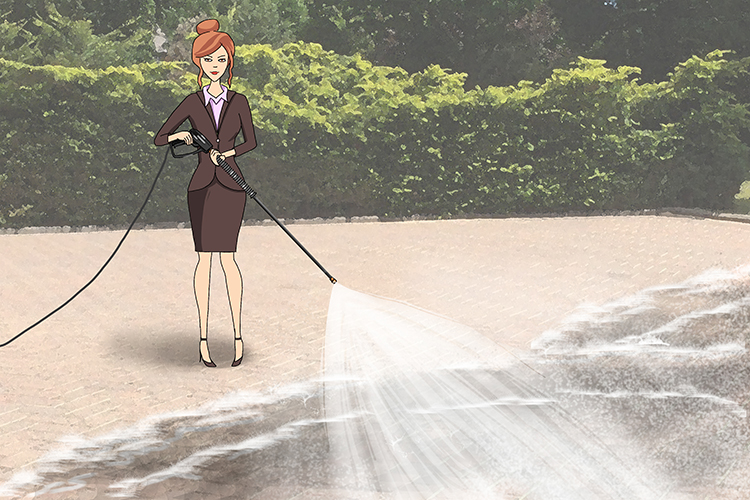
The pressure washer forced water over a wide area (pressure is force over area).
NOTE:
Various units are used for pressure. The ones used in common everyday language include bar, pounds per square inch (psi) and standard atmospheric pressure (atm). However the standard unit you need to know and will most likely have to use in the exam is pascal (Pa) which is equal to 1 Newton per square metre. This unit of measurement was named after a Frenchman called Blaise Pascal. Pascals are small units, so kilopascals (1000 pascals, written kPa) are often used.
To remember that pressure is measured in pascals think of this picture:
The personal assistance sprayed her pa's scalp (pa) with the pressure washer.

Example 1
The graph below shows how atmospheric pressure varies with altitude.
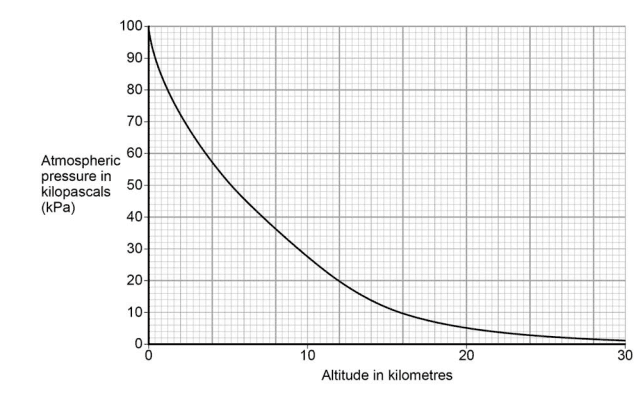
When flying, the pressure inside the cabin of an aircraft is kept at 70 kPa. The aircraft window has an area of `810 cm^2`. Use data from the graph above to calculate the resultant force acting on an aircraft window when the aircraft is flying at an altitude of `12 km`. Give your answer to two significant figures.
Answer
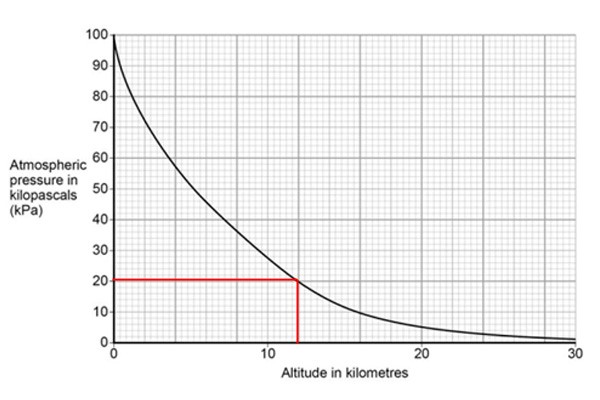
From the graph we can calculate the atmospheric pressure outside the window of the aircraft to be 20kPa.
The area of the window = 810 cm2 = 0.081 m2
Net pressure = 70 kPa – 20 kPa = 50 kPa = 50000 Pa
pressure=\frac{Force}{area}
Multiply both sides by area to make force the subject:
pressure\times area=\ \frac{Force}{\class{strike}{area}}\times \class{strike}{area}
Force = pressure x area
Therefore the resultant Force = 50000 x 0.081 = 4050N.
Correct to two significant figures the resultant Force = 4100N.