speed of S waves – slower or second to P waves
S waves (secondary waves) are about half of the speed of P waves.
To remember that S waves are slower than P waves, use the following mnemonic:
Use the S in S waves to remember the S stands for:
S = Second to primary (first wave)
Or S = Slower than primary
Or S = Slower than primary.
P waves travel at about 8km/s or about 500km/minute and S waves travel at about 4-5km/s or 250km/minute.
As a rule of thumb every 1 minute between the P wave and the S wave is about 500km from the epicentre.
1 minute = 500km
2 minutes = 1,000km
5 minutes = 2,500km
S waves are secondary and are shear waves which are significantly more destructive than P waves (primary waves) because they shake the ground perpendicular, creating intense horizontal and vertical motion. S waves move the ground side-to-side and up-and-down which is far more damaging to building foundations.
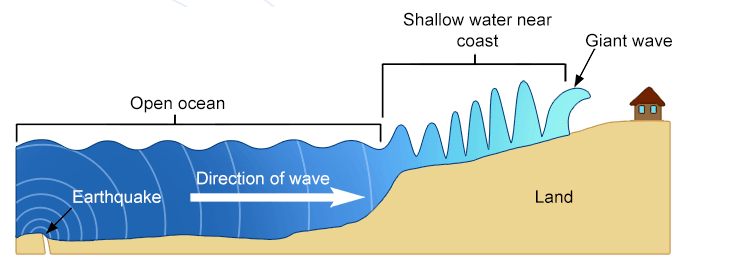
The most destructive power can come from a tsunami which is a long, high sea wave caused by an earthquake.
When an earthquake occurs the sea floor can suddenly move up and down. This movement pushes the water above it. This disturbance creates a series of waves with long wavelengths (sometimes 200km apart) that travel at speeds exceeding 800km/h in deep water. In the deep ocean these waves are only a few inches to a foot high and go unnoticed by ships.
As the waves approach shallower coastal waters, their speed decreases due to friction with the sea floor. The energy causes the water to pile up, increasing the wave's height dramatically - sometimes reaching 30 metres - before it surges onto land. The wave often resembles a fast-moving, high-tide flood rather than a breaking wave.
Major tsunamis can claim hundreds of thousands of lives with the 2004 Indian ocean tsunami resulting in 230,000 deaths. The 2011 Japanese earthquake and tsunami cost £263 billion pounds of damage.