How P and S waves show the Earth has a liquid core
Scientists discovered that S waves (secondary waves) can not pass through liquids and this is how they knew that the interior of the Earth must have liquid in it.
To remember that S waves can not pass through liquid use the following mnemonic and logic.
S waves form the following wave pattern through rock:
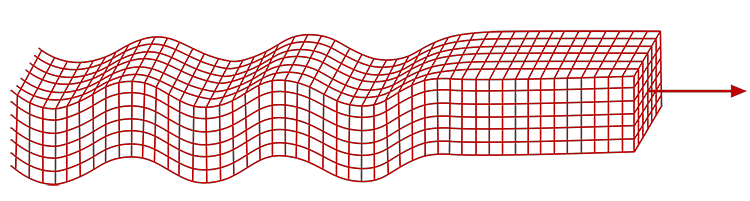
This shear force can not occur inside or through a liquid. A transverse wave needs the material to resist being sheared sideways.
Waves occur only on the surface of liquid because water surface behaves like a stretched membrane so the restoring force comes from surface tension and gravity not from shear strength like solids.
When a big earthquake happens P and S waves travel through the Earth in all directions. Scientists measure them all around the world.
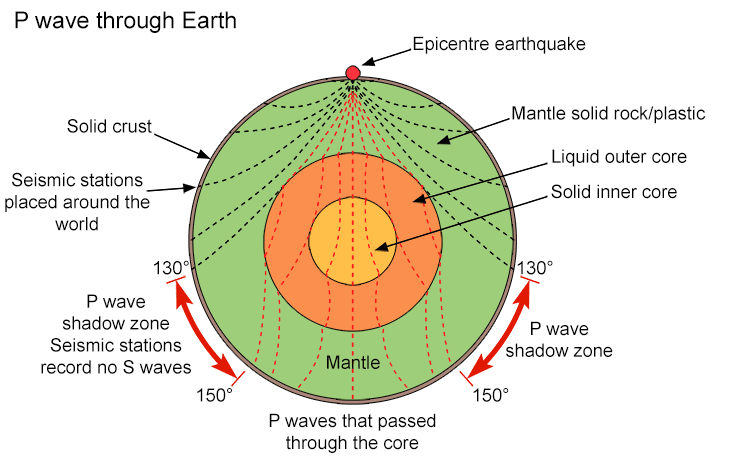
By measuring P waves and S waves, they found that they curved as they passed through a solid due to changing density and material properties. The Earths density increases with depth and waves speed up and refract causing the waves to follow curves paths as they move through the Earth.
S waves (secondary waves) cannot pass through a liquid. When an earthquake occurs scientists found a massive S wave shadow zone around the world i.e. no S waves. From this they could conclude that the Earth must have a liquid core.
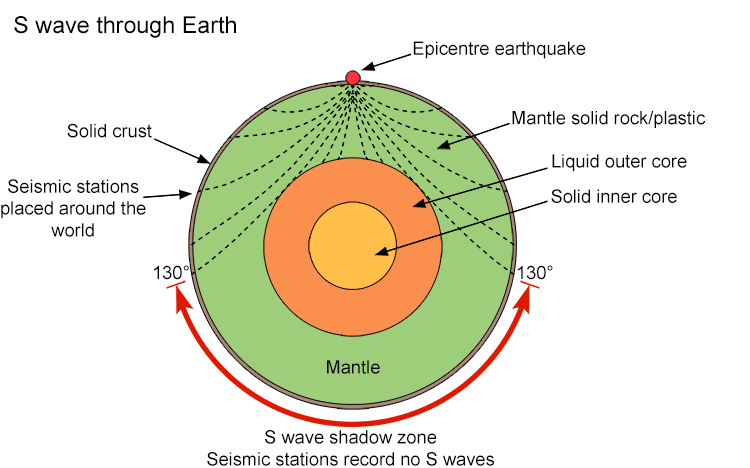
Unlike S waves, P waves (primary waves) can pass through both solid and liquid layers. Even with P waves scientists still found some shadow zones but a much smaller area, but this again proved that there was a liquid core as the P waves refracted (changed direction) when going from solid to liquid.
Combining information about the speed and paths of these P waves the scientists also concluded there was a solid core to the Earth.