static charge – charge caused by an imbalance of positive and negative charges on an objects surface
(pronounced sta-tik)
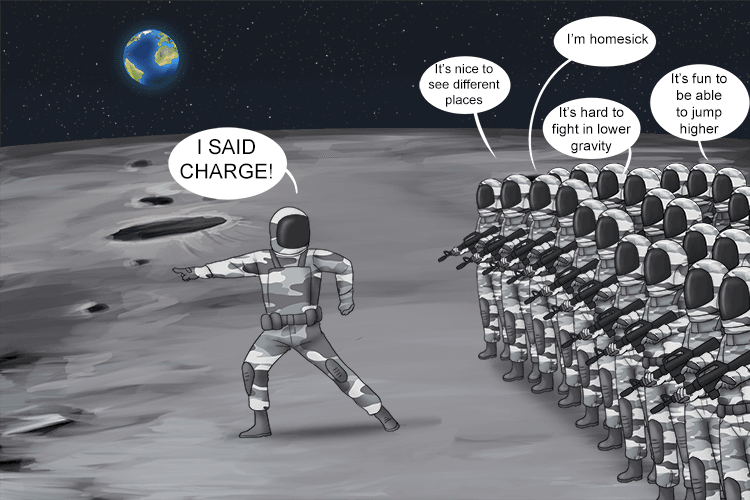
To remember the meaning of static charge, use the following mnemonic:
The soldiers remained static and wouldn't charge (static charge). They were discussing the positives and negatives of war on the moon's surface.
Static charge is the build up of electrical charge on the surface of an object, which occurs when electrons are transferred from one material to another though friction. When two insulating materials are rubbed together, electrons are scraped off one material and deposited onto the other, leaving one object with a positive charge (due to loss of electrons) and the other with a negative charge (due to gain of electrons).
This can be shown when a piece of plastic is rubbed with a cloth.
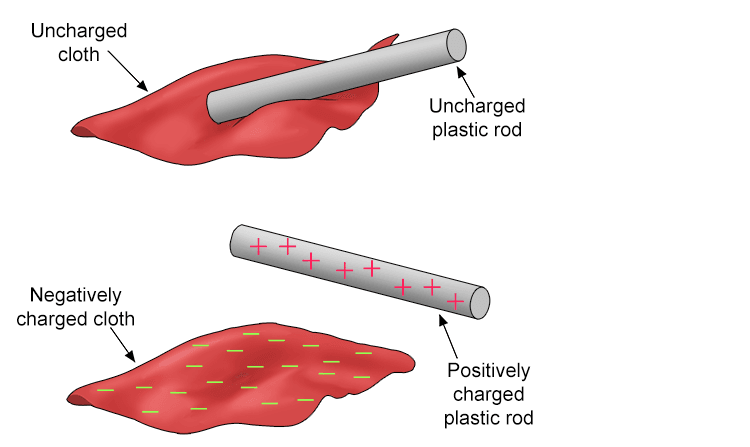
Objects with the same type of charge repel each other, while objects with opposite charges attract each other. Static charge remains on the surface of insulators because the electrons cannot flow freely through the material unlike conductors where charge can move easily.
Common examples of static electricity include rubbing your hair causing it to stick up, or the small electric shock you might feel after walking across a carpet and touching a metal door handle. This shock is caused by built up charge rapidly moving to correct the imbalance, with the quick flow of electrons known as electrostatic discharge.
This is why static build up can be dangerous in environments containing flammable materials, as a spark from an electrostatic discharge could be enough to cause an explosion.