remember the life cycle of a star
The life cycle of a star is as follows:
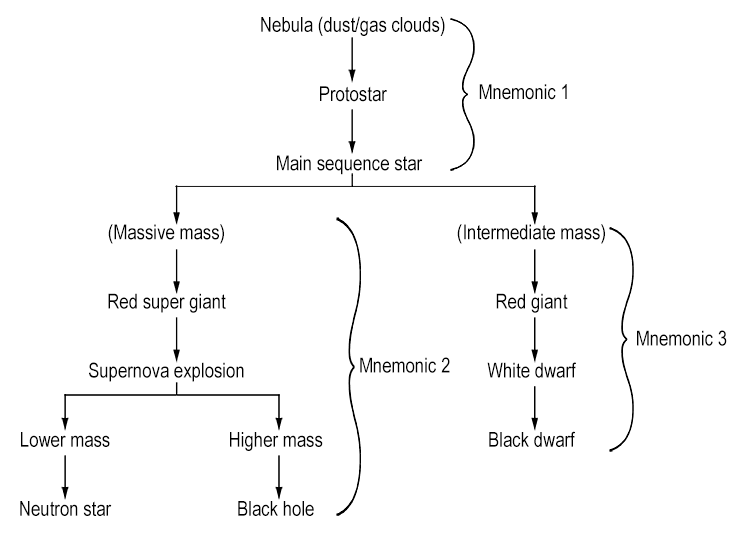
A visual picture of this sequence is as follows:
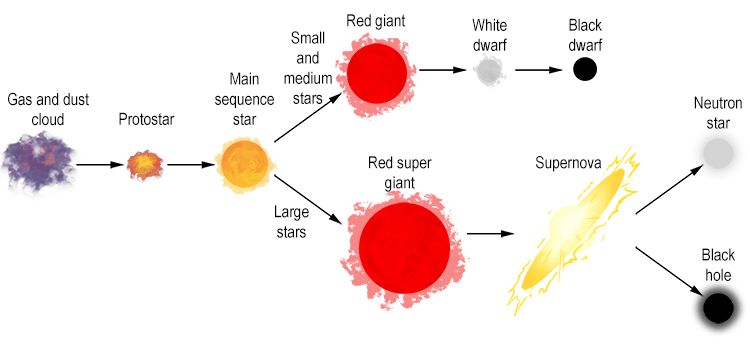
To remember the sequence of the life cycle of a star, use the following mnemonic:
Mnemonic Sequence 1
Go to the theatre and open the stars (all about stars) dressing room.
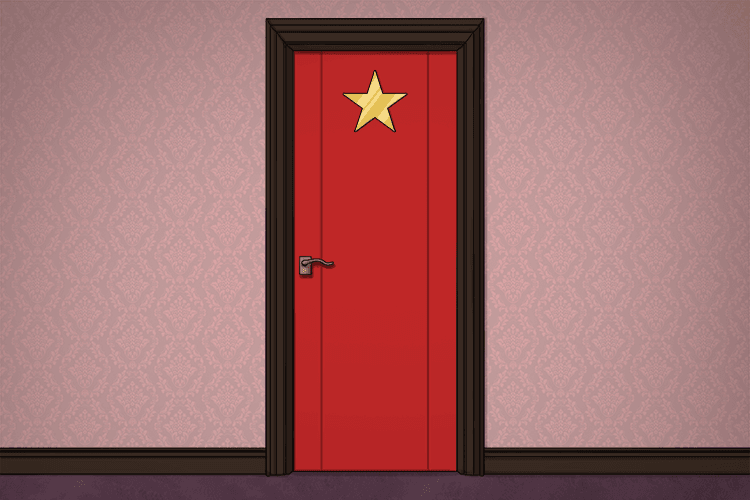
When you open the door the actor is first hooked up to a nebuliser (nebula) which is giving out a fine mist as a gas because the dressing table is so dusty (gas and dust).

The actor gets up and starts posing in front of a professional photographer for the stars (protostar).

A lion with a beautiful mane full of sequins comes over and leads the star (main sequence star) off towards the choice of two doors.
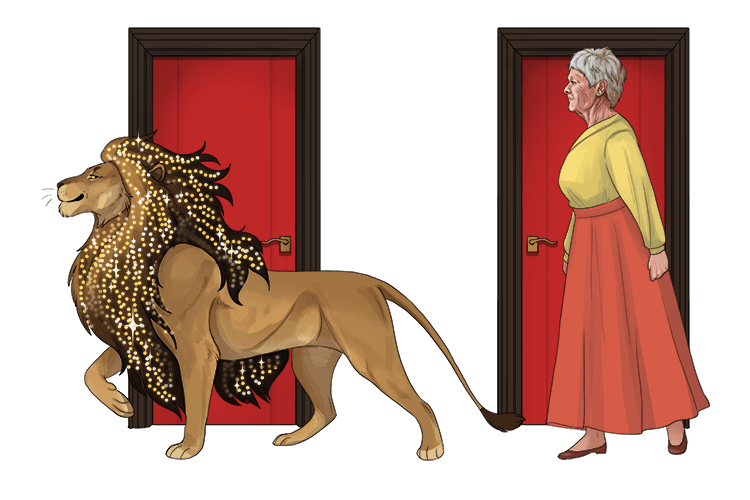
Mnemonic Sequence 2
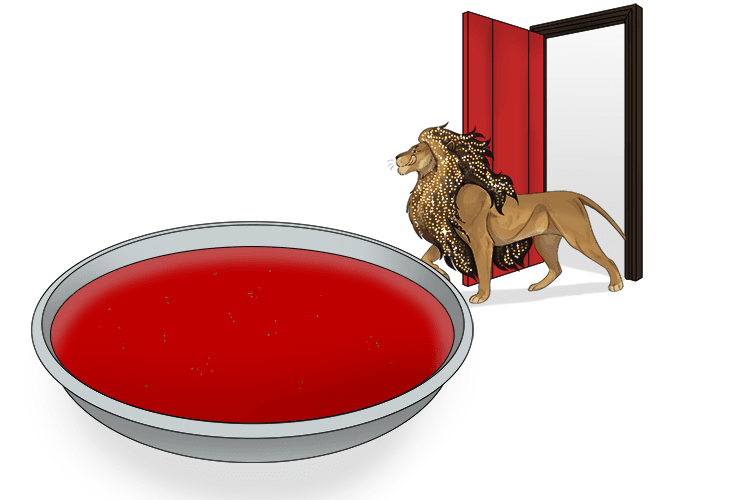
The lion goes through one of the doors, he's looking forward to a meal because he hasn't eaten all day. Inside the room is a red soup and it's giant (red super giant).
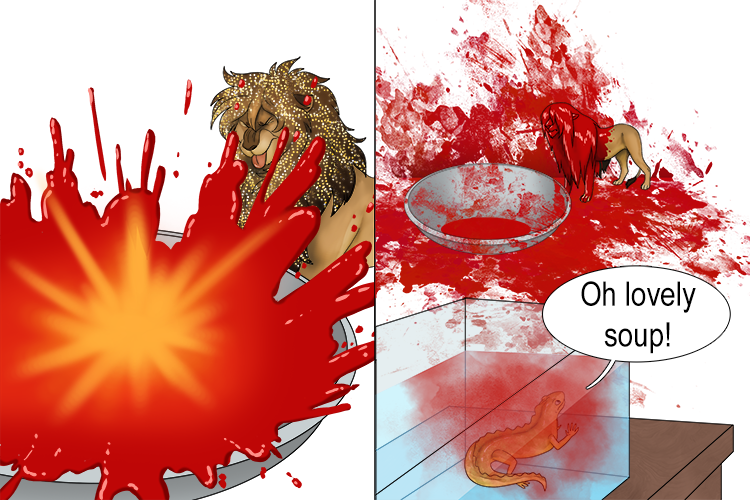
The lion goes to lick up the soup, but it explodes. Some of the soup goes into the newt tank on (neutron star) a table.
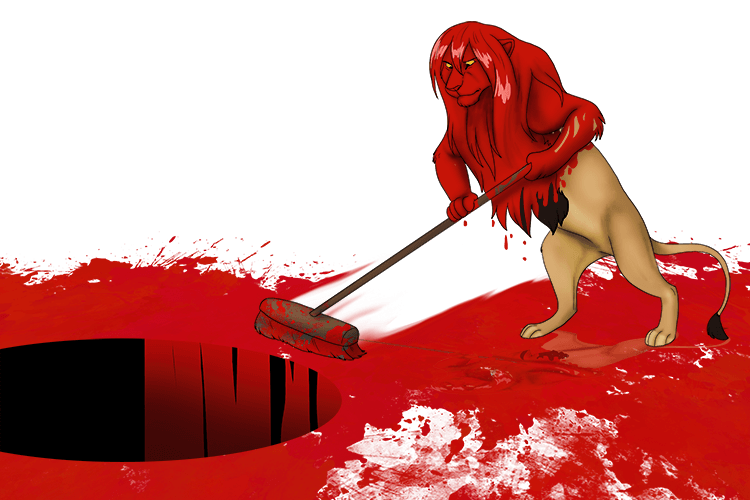
The rest of the soup was all over the floor, it had to be swept into the sewerage hole which is a great big black hole (black dwarf) in the ground.
Mnemonic Sequence 3
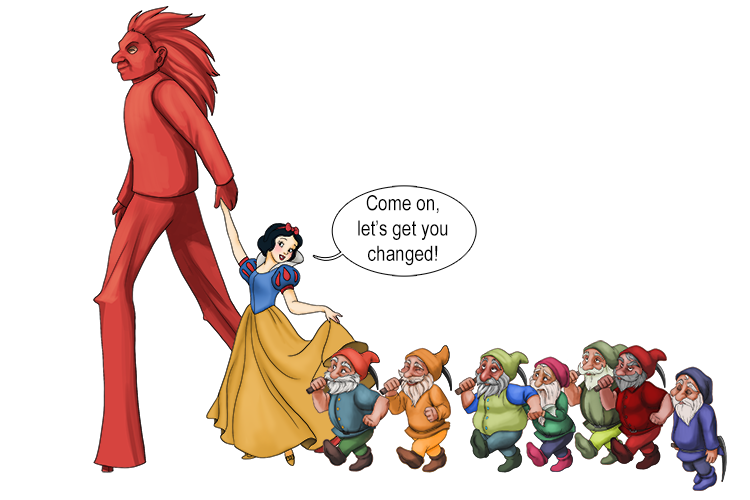
The actor goes into a dressing room and gets dressed up as a big red giant (red giant).
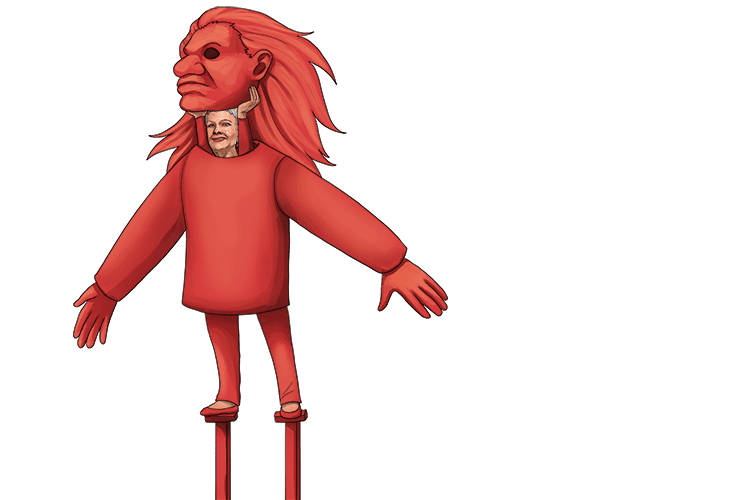
She then holds hands with Snow White and the seven dwarfs (white dwarf).
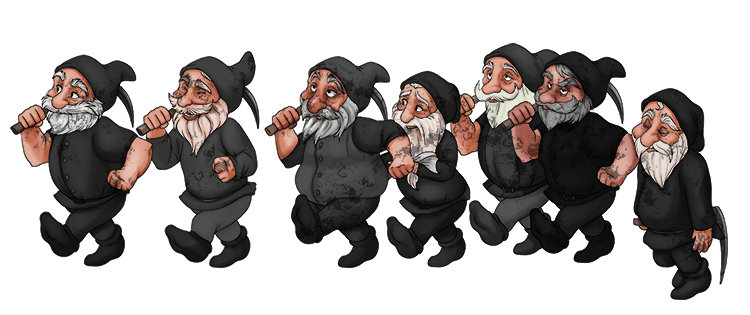
Before the seven dwarfs went on stage, they were dressed in black (black dwarf) to look like they've been working down a mine.
In detail here is the life cycle of a star
1. Nebula - Stars begin in a huge cloud of gas (mostly hydrogen) and dust called nebula. Gravity pulls the particles together until it forms a hot, dense ball.
2. Protostar - As the particles become more dense they collide more often and heat up forming a protostar. It's not a true star yet because nuclear fusion hasn't started.
3. Main sequence star - Eventually hydrogen nuclei gain enough energy that they start to fuse when they collide. This is called nuclear fusion. It's called the main sequence because it's the longest and most stable period of its life during which it fuses hydrogen into helium in its core.
The heat from the centre of the star causes it to expand. The expansion is equal to the gravitational pull towards the centre and therefore this part of the lifecycle is most stable. The larger the star, the hotter and brighter it will be and will move through this stage faster.
Our sun is currently in the main sequence star phase and has 5 billion years left.
Intermediate mass of star
What happens to a main sequence star depends now on its mass!
If the main sequence star is of average mass and has exhausted its hydrogen then it becomes:
1. Red giant - Is a luminous, dying star. The hydrogen in the core runs out, fusion slows down, this means the outward pressure drops and gravity suddenly wins the tug-of-war. Gravity crashes to the core (which is now mostly helium) inwards. This makes the core incredibly hot and dense. The extreme heat from the collapsing core ignites a shell of hydrogen around the core. This shell starts fusing hydrogen into helium. This new burst of fusion energy pushes the stars outer layers outwards, causing the star to swell to enormous sizes (over 100 times its original diameter).
Because the energy is now spread over a much larger surface area, the surface temperature of the star cools down. Cooler surfaces glow with a redder light. The core gets so hot and dense that it starts fusing helium into carbon (ash). When there is no more helium fuel fusion stops completely. The outer layers become unstable and drift away into space as a planetary nebula.
2. White dwarf - What's left behind when fusion stops completely is a white dwarf. It shines because it is still hot - not because it is producing energy.
3. Black dwarf - Over billions and billions of years the white dwarf slowly loses heat. When it has completely cooled and no longer gives off light or heat it comes a black dwarf.
Mass of star is massive
If the main sequence star is massive 8-10 times our sun and has exhausted its hydrogen then it becomes:
1. Red super giant
Just like a red giant, the hydrogen in the core is used up, fusion slows down, the outward pressure drops and gravity suddenly wins. The core collapses and becomes incredibly hot and dense. Just like a red giant the extreme heat from the collapsing core ignites a shell of hydrogen around the core and again the shell starts fusing hydrogen into helium. Again the new burst of fusion energy pushes the stars outer layers outwards. The core again gets so hot and dense that it starts fusing helium into carbon (ash).
The main difference now between the red giant and red super giant is that the red super giants outer layers are so hot that you get multiple shells fusing different elements. The fusing won't stop at carbon:
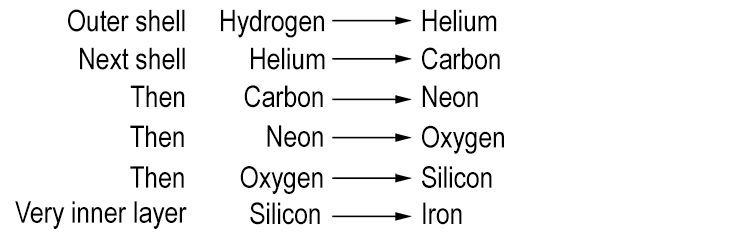
In red super giants the core collapses, fusion continues in shells around the core. Hydrogen fuses in the outer shell and heavier elements fuse in inner shells like layers on an onion. Fusion stops completely when the core turns into iron and actually takes energy away from the core.
In a red giant the core is not massive enough to fuse carbon into anything else.
2. Supernova explosion
At this point the outward pressure vanishes instantly. There is nothing left to fight gravity. The core collapses catastrophically in less than a second. The core collapses, bounces and creates the supernova explosion.
Once iron builds up in the core, fusion stops, gravity wins and the star explodes.
A supernova explosion releases as much energy in a few minutes as the Sun does in a 10 billion years and becomes one of the brightest objects in the universe.
What happens next is two choices depending on what is left.
Choice 1 - the cores mass is intermediate:
A neutron star - they survive a supernova but are so dense that a single teaspoon of neutron star would weigh approximately 100 million tons. It's so dense that it crushes the protons and electrons together. They merge to form neutrons. The result is a ball made entirely of neutrons, hence the neutron star. Like a white dwarf, there is no fusion happening. It is a dead cooling object. When the core collapses its like an ice skater pulling their arms in. Neutron stars can spin hundreds of times per second. They have immensely powerful magnetic fields that trap beams of radiation. If the magnetic poles aren't aligned with the spin axis the beams sweep around like a lighthouse. On Earth we can see a pulse of radiation which we call pulsars.
Choice 2 - the core mass is massive:
The remaining core mass is so massive and the gravity so strong that not even light can escape. The entire mass of the stars core is compressed into a tiny point with near infinite density known as a singularity. There is an Event Horizon, which is a point of no return. It is a boundary surrounding the singularity and anything passing inside this boundary is trapped, allowing the black hole to grow by consuming surrounding gas and matter.