S-wave – transverse seismic waves produced by earthquakes; secondary waves
Note: Think S for secondary and S for shape like a wave.
To remember the meaning of S-wave, use their shape as a visual aid:
An S turned on its side resembles the shape of a transverse wave.
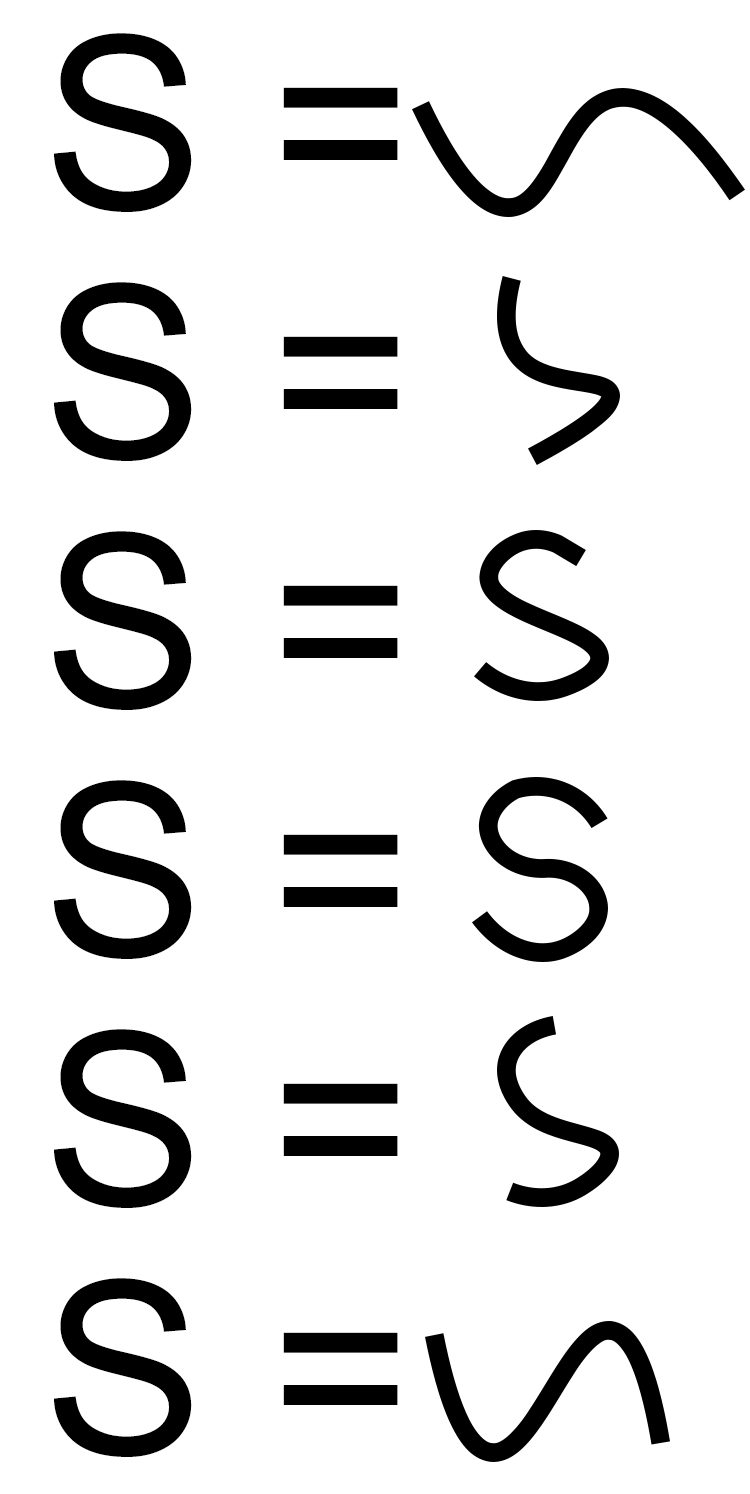
Also, S = Secondary
S = S waves are always second place and therefore slower than primary.
S waves, known as secondary waves, are a type of seismic wave (produced by earthquakes) that travel through the Earth's interior by causing particles in the medium to vibrate perpendicular to the direction of wave travel, in a side-to-side or up-and-down motion. They are called secondary waves because they arrive at seismic recording stations after the faster P wave, making them the second type of wave detected following an earthquake. S waves can only travel through solid materials because liquids and gases cannot sustain the shear forces required for this type of wave motion.
S waves travel at half the speed of P waves and cause more damage during earthquakes due to their shearing motion, which can cause buildings to swap and collapse.
The following image depicts the difference between S waves and P waves, and how scientists present traditional examples of transverse and longitudinal waves.
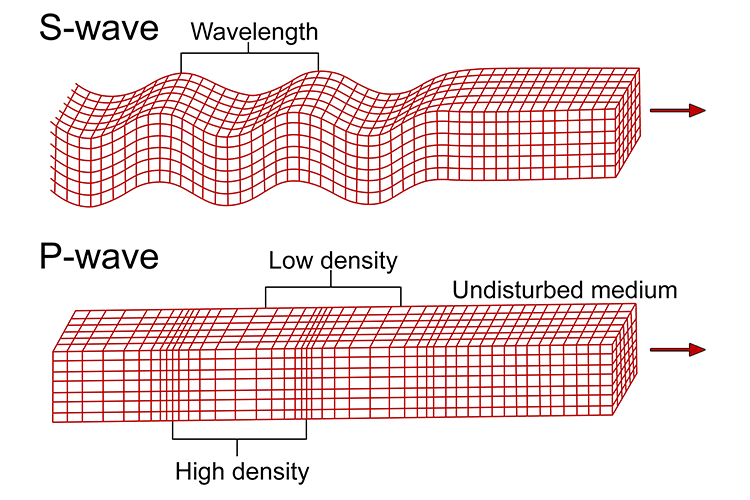
S waves are MECHANICAL transverse waves. S waves move by causing particles to move sideways (perpendicular) to the direction of travel. For this sideways motion to pass from particle to particle, the material must be solid and have shear strength which liquids and gases don't have.
Note: Electromagnetic transverse waves can pass through solids, liquids and gases because they do not need particles to travel through.